


"If a farsighted capitalist had been present at Kitty Hawk, he would have done his successors a huge favour by shooting Orville down"1Warren Buffett
"It is precisely because I understand banks that I never invest in their shares"2Terry Smith
These are two of the more famous quotes on airlines and banking. They are memorable, funny (in Buffett's case), and more importantly, reasonable shortcuts. Most airlines are bad businesses that operate in a commoditised industry with enormous, lumpy capital requirements. Most banks are heavily leveraged, black box operators in an industry where the injudicious activities of your peers can destroy you too. So, it might be rational to aggressively filter out industries with unattractive characteristics. As Buffett puts it:
"I'm like a basketball coach. I go out on the street and look for seven-footers. If some guy comes up to me and says, 'I'm five-six, but you ought to see me handle the ball', I'm not interested"3
But one must remember that investor letters or biographies are often written to be quoted. The best investment writers - Buffett, Smith, Marks - are writing with dual purpose, both to inform their readers about their lives or activities and to market their funds or companies. Funny or quotable statements get a far wider distribution than nuanced, convoluted ones, and as a result they often harden into consensus views.
By adopting those views, however, it's possible to miss out on big opportunities. Indeed, we are of the view that great investments rarely arrive without some level of discomfort, which itself tends to follow a predictable pattern. The chart below shows a pattern in share prices that we often observe in public companies:
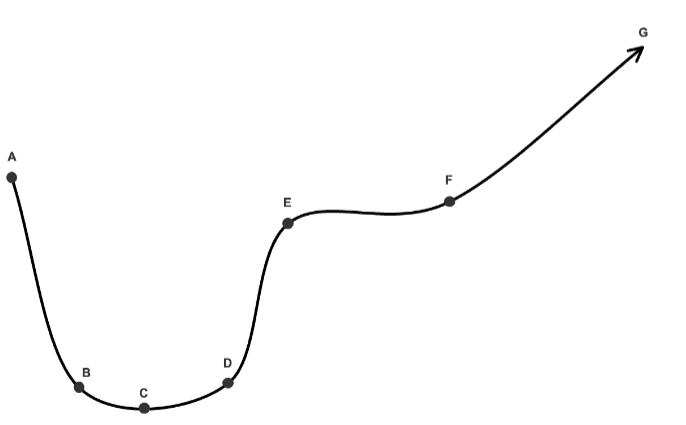
There are six phases to the lifecycle of an investment:
- (A-B): The company is announcing bad news, the stock falls on analysts' downgrades and sentiment gets progressively worse
- (B-C): The share price stabilises but the fundamental performance is still negative, analysts keep downgrading and sentiment remains poor
- (C-D): The price is stable, but the fundamentals begin to improve. Analysts don't adjust and neither does sentiment
- (D-E): Sustained positive news triggers a re-rating, the share price rises and analysts begin to upgrade, sentiment becomes positive
- (E-F): Price stabilises after getting ahead of itself, fundamentals are still improving, analysts are still upgrading, sentiment is still positive
- (F-G): Compounding phase, the longer this continues, the stronger the sentiment
The duration of each phase is unknowable in advance. This matters most in the trough (C-D), where persistent headwinds, structural change or entrenched dogma can extend it beyond any reasonable expectation. Even when the inflection point comes, it's not always obvious until after the fact. A sector where fundamental performance has been poorer for longer and where that received wisdom has become reality might remain unloved for decades at a time. Further, investment horizons in the industry are often shorter than the cycle, and therefore even those who might recognise the opportunity may not be able to act: being wrong for two years whilst waiting for the cycle to turn might cost you your job.
The paradox is that heuristics appear their most correct precisely when the cost of adhering to them may be at its highest. Point C on the graph represents the point of maximal discomfort for the investor: the share price is trashed and those who avoided the sector feel fully vindicated. At this point in the investment cycle, almost every piece of data will hammer this home. Further, those pithy quotes start doing the rounds once more and the new oracles who correctly foresaw the disaster are anointed. This wave of negativity acts as an obstacle to investor interest: it's hard to justify allocating one's time to troubled industries when more exciting narratives abound elsewhere.
Three behavioural biases reinforce this dynamic and UK banks illustrate each of them clearly.
The first is loss aversion, which is where people feel losses much more than they do the equivalent gain. From October 2007 to June 2009, investors in RBS or Lloyds ended up losing 90%+ of their initial capital. Taking such losses leaves deep emotional scars long after the event has passed.
The second bias, the availability heuristic, compounds this. This is where people judge events or ideas based on how readily examples come to mind. As sustained losses feel incredibly vivid it's easy to see how the two feed into one another. Most people will have strong memories of queues outside Northern Rock, bailouts on the front pages of newspapers, or scandals like PPI, and bank investors even more so. Each new headline, even when unrelated, pours petrol on the availability/loss aversion bonfire. So much so that even when the underlying business has changed, it's hard to notice.
The third is social proof, which is where we use the words of others, often in positions of authority, as a defence for our own actions. The social proof of having Terry Smith ideologically aligned to oneself makes the avoidance of those sectors feel more comfortable to the individual, and more easily explainable to one's boss. If you avoid banks and they rally, few people will remember whereas if you invest and they halve, it might be a career-limiting error. As John Maynard Keynes observed, it's better for one's reputation to fail conventionally than to succeed unconventionally4.
Each bias exacerbates the others: the loss is felt deeply, springs to mind easily, and gets validation from prominent peers. They ensure that the crowd will be slowest to update its views precisely when it is most advantageous to do so.
Of course, the crowd can be right too. Not every sector will recover, and some genuinely don't have any redeeming qualities, so structurally avoiding these is a rational strategy. This, though, is not the same as saying no opportunity exists. Heuristics are generalisations, and as with all generalisations, they leave room for edge cases and opportunities. We believe the best way to benefit from these opportunities is through doing one's own primary research in depth, which helps the investor understand whether it's an industry that's changed or merely the narrative around it.
So, to rework Buffett's phrasing, sometimes it's spending a bit of time evaluating the five-foot-six player to see if they can handle the ball.
1 Warren Buffett, 2007 Berkshire Hathaway shareholder letter
2 Terry Smith, "Why I don't own bank shares," Financial Times, 2014, fundsmith.co.uk/news/2014/2083
3 Janet Lowe, Warren Buffett Speaks, Wiley, 2007
4 John Maynard Keynes, The General Theory of Employment, Interest and Money, 1936